

The Movies That Made Me A Lesbian
To celebrate Lesbian Day of Visibility 2020, our Char takes a look at her favourite films and asks whether queer representation in movies still matters.
My favourite film of all time is a sappy American sports movie with a win for the underdog. When folks ask, “What’s your favourite film?”, I expect they’re anticipating a high brow, or at least edgier, response from me. After all, I work in the arts and am responsible for programming a major LGBTQIA cultural festival. Yet since I was 10-years-old and first saw A League of Their Own on rented VHS at my neighbour’s house, it has been undisputedly and unashamedly my favourite film.
This 1992 movie starring Geena Davies and Tom Hanks fictionalised the early years of professional women’s baseball, founded during WWII to fill the gap left by men’s teams signing up to the US Army. Okay, so did I mention this is a film about women’s sports? Oh yeah, it also stars Madonna (queer icon), Lori Petty (gay) and Rosie O’Donnell (super gay).
The film offers a rare female-focused storyline that centres around relationships between women and other women, whether friends, teammates or siblings. When I first watched the movie, I was a tomboy fast approaching puberty and heading towards Secondary School. I was starting to feel the effects of gender stereotypes and knew that I didn’t fit the mould of what it was to be a girl. My ears pricked up when Rosie O’Donnell’s character Doris Murphy explained how she had been made to feel, “Like I was some sort of weird girl or a strange girl, or not even a girl, just ‘cause I could play [baseball]. I believed them too, but not anymore.” A League of Their Own gave me permission to be myself; ripped jeans, baseball cap, kicking a ball around my cul-de-sac.
Disney’s original tomboy movie Mulan came into my life a little later, when I was 14-years-old. I loved the film with a passion although I couldn’t work out why the song ‘Reflection’ resonated quite so strongly:
Look at me / You may think you see / Who I really am
But you'll never know me
Every day / It's as if I play a part
Now I see / If I wear a mask / I can fool the world
But I cannot fool my heart.
And I didn’t give a crap about the romance between Mulan and Li Shang, it felt like an unnecessary distraction from the main story. Disney’s new live action version of Mulan (set for release post-lockdown) has apparently dropped the romance entirely; perhaps it will resonate even more strongly with today’s movie watching baby-gays.
Growing up in the 1990s, there weren’t any visible queer women in any of the movies I could easily lay my hands on. I’m not sure I even knew what the word lesbian meant until I was well into my teens. Although not always favourable, gay men and drag queens were beginning to find some edge-of-the-mainstream representation (think Philadelphia, The Sum of Us, Priscilla Queen of the Desert and The Birdcage, to name a handful). So while they were never queer, all of my favourite movies did feature (in Netflix lingo) a “strong female lead”. There was Whoopi Goldberg’s Sister Act (yes queers, that’s a movie about nuns set in San Francisco!) and 10 Things I Hate About You (although the line about Bianca possibly being a k.d. lang fan went over my little closeted head for years).
Then there was a vintage favourite. Made in 1953 (a movie of it’s time, unfortunately the film does harbor some racist and sexist content), Calamity Jane is a musical based on the true story of Martha Jane Canary, an amiable, cross-dressing cowgirl from American’s turn of the century Wild West. Portrayed with humour and charm by a very beautiful Doris Day, Calamity is mocked for her masculine ways. After taking in the showgirl Katie Brown and (literally) singing the virtues of a woman's touch (head out of the gutter please, the song refers to interior design and housework), Calam attempts to become more femme only to ruin her bloomers when she falls in the “damn crick”! While Calamity gets her happy ending in the arms of a man, what always stayed with me about this movie is that her masculinity isn’t erased. Even as a betrothed woman, she still wears trousers and gallops around on horses being brave and bold. The movie taught me that women could do these things and have a happy ending. Even if I did wince a little every time Calam and Bill kissed.

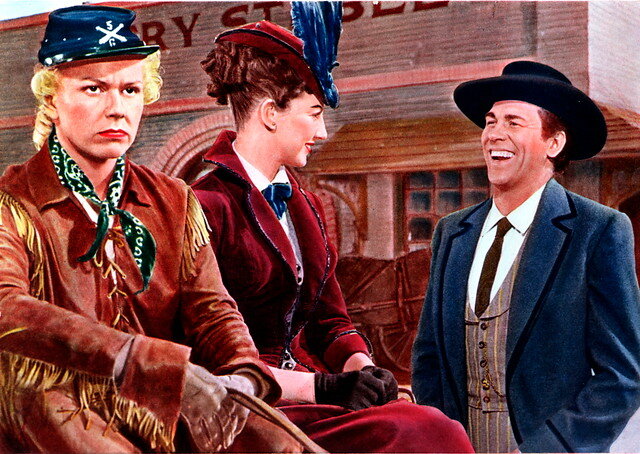
Calamity Jane (Image via: cinemamuseum.org.uk
I love all of these movies with a passion, but there is an unfortunate trope that runs through them. For all of my movie heroines, despite being strong independent women, the movie trajectory has them end up with a man (Sister Act aside, unless that man is Jesus!). I was always drawn to tomboys and audacious women who acted in ways that made society shun them. And yet, the plot always headed the same direction; heteronormative forever after.
More recently, I watched with bemusement the campaign to #GiveElsaAGirlfriend aimed at Disney’s Frozen 2. For those of you who’ve had your head under a rock for the last 5 years, Frozen is the story of sisters Elsa and Anna. Anna - the younger sister who has two love interests - is pretty cool, but resolutely, the character the kids want to be is Elsa. Queen Elsa is the older sister who has magical power which she is encouraged to suppress and hide away, for fear of the danger it could put her in. She finally learns how to control these special tendencies through love, not of a man, but of her sister. Vox writer Emily Todd VanDerWerff makes a compelling argument for Elsa being queer, but concludes that Disney is never (and probably will never) be explict about this.
Does it matter? It all comes back to that old idiom, ‘You’ve got to see it to be it’. And that isn’t to say that seeing someone gay will make you gay; the title of this piece is tongue in cheek, obvs! Rather, the feelings that I had no name for weren’t validated when I was young. In turn, it took a really long time and a lot of heartache for me to work it all out.
But there is hope. Generation Z is entirely more comfortable than Millennials ever were in accepting sexuality and gender. Teen TV shows like the hugely compelling Netflix original Anne with an E (which has outrageously been cancelled after 3 seasons!) offers explicit queer characters, warmly treated with their own nuanced storylines and fully formed characters. The funny thing is, why in 2020, does this feel like such a treat, like something so special? The existence of queer characters in family-friendly entertainment still feels so damn progressive, when it could, or it should, just feel commonplace.


